The first time I opened an AIA billing document, I honestly thought, “There is no way I’m ever going to figure this thing out.”
Rows, columns, retainage, previous applications, percentage complete, stored materials… it felt like I was trying to read a foreign language.
If you’re a new contractor breaking into commercial construction, you’re probably feeling the exact same way.
Here’s the good news:
Every experienced commercial contractor was once confused by the AIA billing form.
The difference between them and you isn’t intelligence—it’s simply experience.
What Is an AIA Billing Document?
Most commercial construction projects don’t allow you to simply send an invoice when you want to get paid.
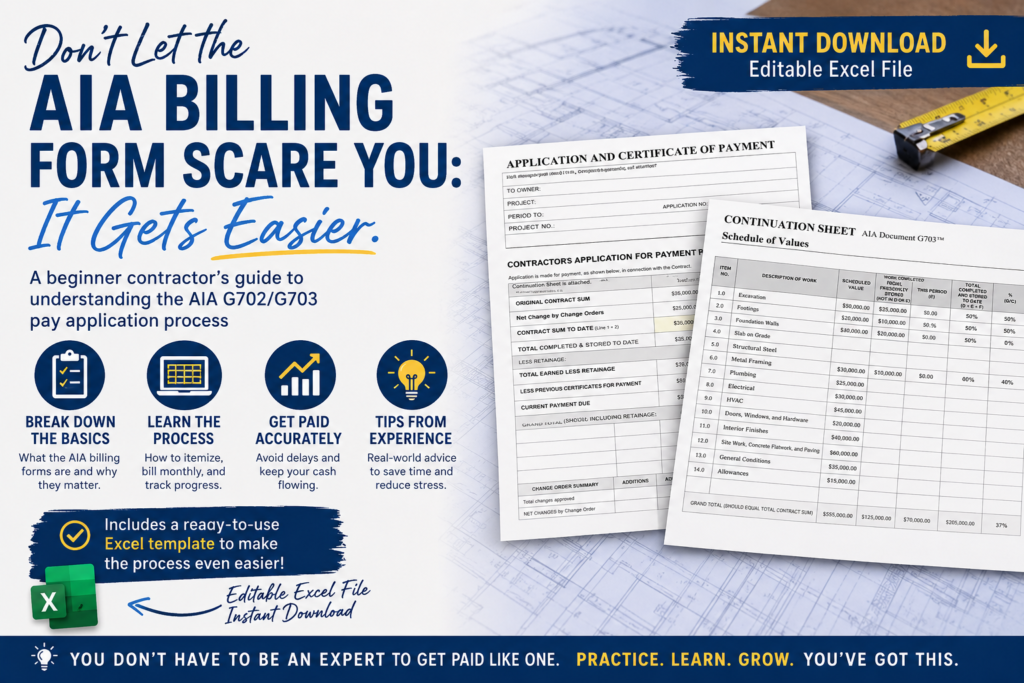
Instead, you’ll likely submit an AIA G702 Application for Payment along with the G703 Continuation Sheet, which serves as the Schedule of Values. Together, these forms show the owner or general contractor exactly what work has been completed, what was previously billed, what is being billed this month, and how much remains on the contract.
Unlike residential work where you might invoice after completing a phase of the job, commercial projects are typically billed monthly based on progress.
Here Is where I get mine:
Why It Feels So Confusing
When you first start using an AIA pay application, you’re expected to break your contract into individual line items.
For example:
- Footings
- Foundation Walls
- Slab
- Reinforcing Steel
- Formwork
- Site Concrete
- Mobilization
Each item receives a dollar value that adds up to your contract amount.
Every month you’ll update how much work has been completed for each line item. What you billed last month moves into the “previously completed” column, and the current month’s work is entered separately. The spreadsheet then calculates the totals, remaining balance, retainage, and payment request automatically.
Once you understand the flow, it starts making sense.
The first few times?
Not so much.
My Biggest Piece of Advice
Don’t panic.
Seriously.
I remember staring at the spreadsheet wondering if I was cut out for commercial construction.
Today, it’s simply another part of running the business.
Like estimating, payroll, or taxes, it feels overwhelming until you’ve done it several times.
Then one day you realize…
“Oh…this isn’t nearly as complicated as I thought.”
The Spreadsheet Does Most of the Math
One thing that helped me tremendously was purchasing a pre-built Excel template.
Instead of building formulas from scratch, I bought a blank AIA billing spreadsheet on Etsy that was already set up and ready to use. I simply entered my Schedule of Values, updated the monthly progress, and let Excel handle the calculations.
If you’re just getting started, using a professionally built template can save you hours of frustration and reduce the chance of formula errors.
(I’ll link the template I use below if you’re looking for a good starting point.)
Accuracy Matters
One thing I’ve learned is that these forms aren’t just paperwork—they’re directly tied to your cash flow.
If the numbers don’t reconcile or a line item is entered incorrectly, your payment can be delayed while corrections are made. Since commercial projects often involve substantial monthly draws, taking the time to review each pay application carefully is well worth it.
Don’t Let Paperwork Hold You Back
I’ve talked to contractors who avoid bidding commercial work because they’re intimidated by the paperwork.
That’s unfortunate because commercial projects can offer tremendous opportunities to grow your business.
Learning the AIA billing process is simply another business skill.
Nobody is born knowing how to complete a pay application.
Nobody is born knowing QuickBooks.
Nobody is born knowing how to estimate a million-dollar project.
These are all skills that are learned through repetition.
Final Thoughts
If you’re just starting out, give yourself some grace.
Your first AIA pay application will probably take much longer than your tenth.
Your tenth will take longer than your fiftieth.
Eventually, it becomes just another monthly task that keeps your projects moving and your business getting paid.
Don’t let an intimidating spreadsheet convince you that commercial construction isn’t for you.
Some of the best opportunities in construction come from being willing to learn the things that seem difficult at first.
Trust the process.
One pay application at a time.